PM, TPM, and EM: A Practical Framework for Technical Leadership Roles


For years, the question “TPM vs PM vs EM” quietly stressed me out.
Not in a theoretical way, but in a very real “I have no idea what I actually want to be” way. Not because I was overthinking titles, but because my early career created a lot of mixed signals. The other part was simple: I did not really understand the differences myself. And honestly, many people still do not.
This is the article I wish I had early in my career. It is not a textbook definition. It is the lived view of someone who has been an engineer, an accidental PM, a pseudo EM, and finally a TPM.

How the Confusion Started
I started my career as a Java engineer in a consulting firm. You wrote code, became a senior developer, then eventually “moved up” into project manager role. That pattern made me believe:
Developer → Senior Developer → Lead → Project Manager.
So I decided, “I want to become a project manager.” That felt like the next big promotion, the point where you stop coding and “run the show.” Then I moved to the US for my master’s in Management Information Management and doubled down on that dream.
The first shock: “Project Manager” in practice
During my time at Syracuse, I interviewed for a Bank of America tech internship. They told me I had been selected by the Project Management team. Perfect. I thought I had made it. Then reality arrived.
In that environment, project managers did not have direct reports. They were not engineering managers. They did not own people or architecture decisions. They owned schedules, risks, dependencies, and status.
Engineers reported to engineering managers. PMs were assigned to initiatives, not teams.
It was my first lesson: Titles lie if you do not understand the context.
Wearing every hat at once
After my internship, I joined Walmart as a “Senior Project Specialist.” The title was vague, but I was excited. My job was to roll out a DevOps change and release management product across the company. Within months, my curiosity pulled me deep into the system. I was:
- Configuring tool, Understanding architecture, Troubleshooting issues
- Managing releasee, Training users, Driving adoption
On paper I was some sort of Project person. In reality I was:
- Doing project management; Acting as product owner
- Doing technical troubleshooting; Playing partial engineer
Over years I played this role where I wore multiple hats acting as Software Engineer, Product Manager, Release Manager, and a Project Manager.
I did not have the vocabulary for it at that time. I just did the work.
Cloud Migration: Program, Product, and Engineering in one
When cloud migration became a big initiative, I asked to help. An external PM had been hired, but progress was slow. My director had seen my work, so he asked me to drive it.
For the next two years I:
- Managed a large migration ; Worked with multiple engineering teams
- Learned Azure architecture; Deployed systems myself
- Wrote Python and shell scripts; Coordinated vendors and internal teams
Again, I was living in the overlap of PM, TPM, EM, and engineer without clear labels. At some point I had to pause and ask:
What am I actually supposed to become?
That question pushed me to seriously study the three roles everyone kept talking about: PM, TPM, and EM. I interviewed many industry professionals.
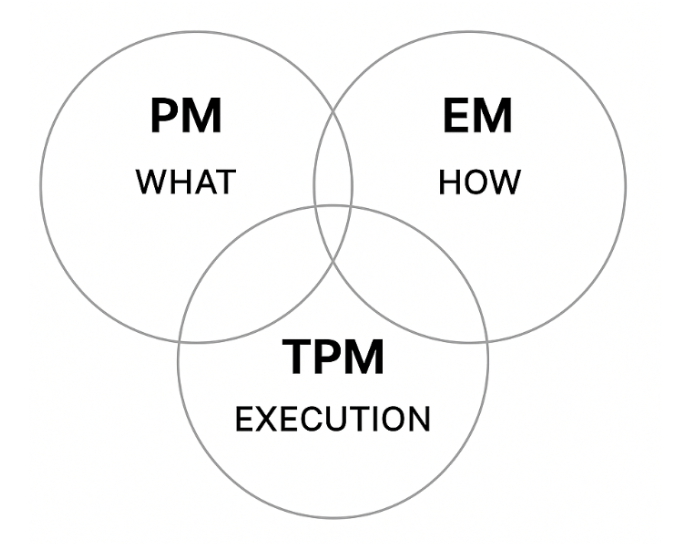
The Core Framework: PM vs TPM vs EM in One Line
Here is the simplest way I have found to think about these roles:
- PM (Product Manager): Owns what and why
- EM (Engineering Manager): Owns how and who
- TPM (Technical Program Manager): Owns how and when across teams
They live in the same universe but solve different problems. Let us go one by one.
What Product Managers Actually Do
Early on, I thought PMs were “mini CEOs.” It sounded glamorous and vague. In reality, strong PMs obsess about:
- What problem are we solving, Why it matters, Who the user is, What success looks like, How to prioritize trade offs
Their world revolves around: Product vision and market fit, Roadmaps, Problem statements, Requirements and PRDs, User journeys and UX, Business impact and metrics
A key insight that helped me:
PMs do not fundamentally own execution. They own direction.
They deeply care about execution, but they do not usually run the cross team delivery machine. They define what should exist and why, then partner with EMs and TPMs to bring it to life. If your brain naturally goes to customer value, competitive landscape, and “Is this worth building at all?”, that is PM energy.
What Engineering Managers Actually Do
Engineering Managers surprised me the most when I finally understood their real job. In some environments they are seen as “senior engineers who also manage people.” In modern tech orgs, EMs have two big responsibilities:
- Own the quality and health of engineering execution
- Hire, grow, and support engineers
They focus on:
- Architecture and design decisions; Code quality and technical standards
- Reliability, on call, and incident response; Engineering processes and execution
- Hiring, coaching, and performance reviews; Team culture and health
If PMs are asking “What should we build and why?”, and TPMs are asking “How do we ship this across teams predictably?”, EMs are asking:
“How do we build this well with the engineers we have?”
They own the technical bar and the people who write the code. If system design discussions, mentoring engineers, and improving technical quality energize you, EM might be your lane.
What Technical Program Managers Actually Do
TPM was the role that took me the longest to understand, even though I was already doing that work. Eventually, I realized TPMs sit between PM and EM, but they are not a mix of the two. They solve their own category of problems.
Strong TPMs own four things:
- Execution across teams: Not “one team shipping one feature”, but “five teams aligning, integrating, migrating, and shipping something complex together.”
- Technical clarity: TPMs go deep enough to understand: Architecture, Dependencies, Integration points, Migration steps, Failure modes and risks
- Cross org coordination: They are the ones who see the whole board and keep all players aligned.
- Predictable execution: This is the real superpower. Turning chaos into a plan. Breaking ambiguity into milestones. Driving programs from “vague idea” to “shipped in production.”
The questions TPMs ask all day:
- How will all these teams work together?
- What are the dependencies and risks?
- What is blocking progress?
- How do we sequence this and Report?
- Are we on track for the date we committed?
In one line:
PM: what and why | EM: how and why | TPM: how and when
Why These Roles Are So Easy To Confuse
In the real world:
- Some companies expect PMs to run projects
- Some expect EMs to do all the program management
- Many teams do not have TPMs at all
- Titles change meaning between companies and countries
- Do not have dedicated Product Managers
- Mix responsibilities across senior engineers, EMs, and whoever cares the most
This is how you end up “secretly” doing PM or TPM work without the title.
I have been the engineer writing scripts, the PM shaping internal product direction, the TPM driving cross team execution, and the EM shaped leader influencing design. Often in the same quarter. That is normal in infra. It is also exactly why you need a clear internal framework.
How I Finally Realized I Was a TPM
At one point, I sat down and wrote out what I had actually been doing for the past five years. The list looked like this:
- I loved leading and finding breaking points
- Taking ambiguous, messy programs
- Breaking them into clear milestones
- Understanding systems end to end
- Mapping dependencies across teams
- Driving architecture and design discussions
- Unblocking issues across orgs
- Owning timelines and execution
- Writing scripts and doing hands on work when needed
- Acting as glue between product, infra, SRE, and security
Then I compared that against the three roles. It was not pure PM. I was not living in user research and market analysis. It was not pure EM. I was not excited about line management and performance cycles.
What I loved was: Technical depth without full time coding, Complex systems that span many teams, Turning chaos into clear, predictable execution and leading without authority.
That is TPM work.
Once I admitted that to myself, everything clicked. Interviews, role choices, projects, my long term direction. My career finally made sense.
A Simple Self Check To Choose Your Path
Forget titles for a moment. Think about what energizes you.
Choose PM if you think in terms of:
- “What problem are we solving?”
- “Is this valuable for users?”
- “Why should this exist at all?”
- “How do we position this in the market?”
You like strategy, user empathy, and value.
Choose EM if you think in terms of:
- “How do we design and build this correctly?”
- “Will this scale and be reliable?”
- “How do I grow these engineers?”
- “What is the right technical decision for the team?
- You like people leadership plus deep engineering.
Choose TPM if you think in terms of:
- How do we get this done across many teams?
- What depends on what?
- Where is the risk in this plan?
- How do we make this predictable?
- How do we bring clarity to this messy program?
- You like systems thinking, execution, and cross org alignment.
You do not need to be perfect at all three. You just need to notice where your natural energy flows.
Why This Choice Matters
When your role aligns with how your mind naturally works, everything changes. Work feels lighter instead of draining, growth happens faster without forcing it, and you show up more confidently in interviews and promotions. Most importantly, you build a career you can sustain and enjoy over the long term.
For a long time, I tried to fit myself into roles that sounded good on paper. Once I understood the practical differences between PM, TPM, and EM, I stopped fighting my own wiring.
Choosing the TPM path was not about a fancier title. It was about choosing the version of myself that was already there, hidden inside the chaos of infra programs and cloud migrations.
If you are stuck in the same confusion, do this:
- List the work you actually did in the last 12 to 24 months
- See where your heart goes
- Circle the parts that gave you energy, not the ones that just paid the bills
- Map those back to PM, TPM, and EM patterns
Your answer is probably already in that list. The title just needs to catch up.